Is “poor acoustics” part of the building heritage?

I often argue that it is. Acoustics are woven into the record, the significance, and the lived experience of historical buildings. I like the idea that the notes played long ago don’t completely vanish, that the voice of a space lingers, evolved over time.

But what happens when the brief is to rebuild a long-lost concert hall, exactly as per the surviving drawings? And what if the acoustics of that historic design fall short of clients’ and community’s modern expectations?

That’s exactly when the acoustician needs to be brought in early. Before the diggers, before the builders, before the politics.

Sightline assessment

As pointed out in the comments to my previous post, the decision on whether a view is restricted in a performing arts venue often rests with the theatre consultant; a specialist tasked with making that final judgment.

This kind of expertise comes from attending many performances in a wide range of venues. It’s about recognising spatial relationships and understanding from these experiences, whether other people are likely to be annoyed every time, occasionally, or not at all.

Which makes me wonder:
If the responsibility is put on someone(s) who rarely (or never) attends live performances, how can they be expected to know when a sightline might be a problem?

Harry Clark Prize

The Harry Clark Prize for room acoustics is named after the acoustician who, in 1919, was engaged by the Chairman of the House and Furnishing Committee of the House of Representatives in Wellington, New Zealand.

His report on the reasons why the Chamber in the new parliament building had poor acoustics is a remarkable 8-page document full of a comments and observations that are simply true. Most of these truths would be confirmed decades later by experiment. A long way ahead of his time.

My paper Recent development in Visualisations for Acoustics was awarded the inaugural paper. In the paper, I demonstrate how visualisation does not have to be static, engineered and complex. That in fact, it can speak for itself to a non-technical audience, while providing a mean to check that a concert hall design serves all sections of the orchestra. A win-win.

In the presentation, I simply emphasized the need to rethink our undecipherable reports filled with complex graphics, and instead, to reimagine how we visualize sound in performance spaces. Here is an example, with sound:

Visualizing sound reflections (Part 2)

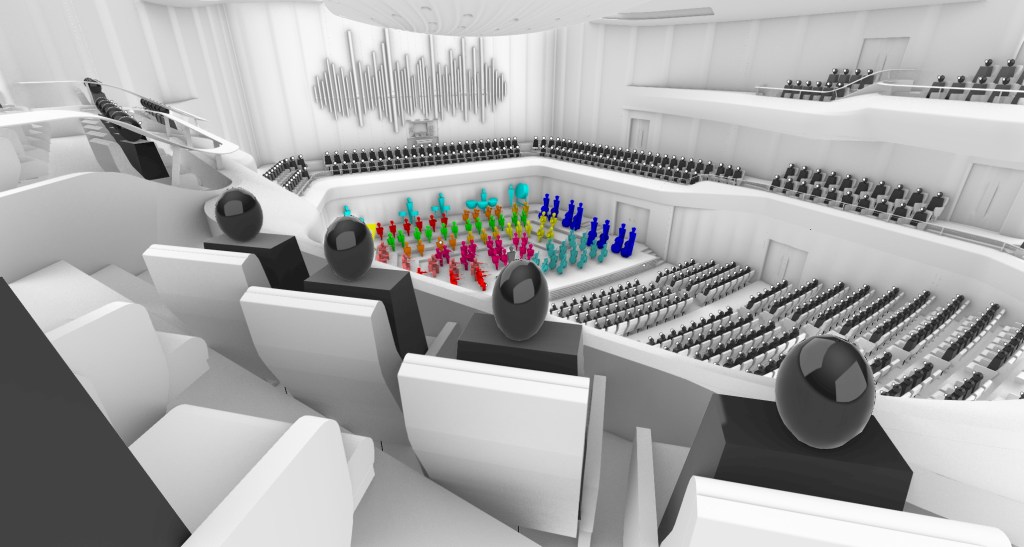
Following up on the popular topic of visualizing sound reflections (see previous post), we want to highlight the benefit of developing systematic tools to illustrates, qualitatively, the acoustical merits of a design (or a design change).

Designs that do not support all orchestral sections sufficiently often result in an imbalance of the orchestral sound or noticeable variations depending on where the performer stands. Indeed, most simulation packages start with the source definition in a 3-dimensional space from which all calculations start, after all, the hall is an extension of the musical instrument.

We suggest here that the opposite must also be achieved. The whole stage imaging requires the analysis to be carried out from the listener’s point of view as well. It is not always enough to design assuming one source position at the time, especially the design relies on carefully developed reflection sequences.

Considering the orchestral balance, as heard by the audience, is a respectable goal and many would agree with this but few report or quantify it. It is assumed to be part of the design elements left to “experience” and “know-how”. Acoustic briefs could include requirements such as “The acoustic design of the hall should demonstrate provisions for all areas of the stage and sections in the orchestra”. One of the reasons might be that it is highly related to the artistic direction of the orchestra, the aspirations for the venues and preferences of a conductor, of the moment. Another reason is simply that there is no simple way to check it.

Until this:

And yet, there is more to come!
Talk soon!

Visualizing sound reflections

In 2013 at ISRA conference in Toronto, I presented work on parametric design done with Zaha Hadid Architects in Hong Kong for the Changsha Mexihu Opera House. And some acousticians in the audience asked me why I was giving so much power away to the architect! I was shocked by this question (and didn’t have a great response on the spot). I never thought like that about architects and have always wanted to invite them into the acoustic design (and still do). The more engaged we are with one another, the better off the acoustic and architectural outcome for the project. Sadly, not everyone things like that.

There is more to acoustic design than “trust me”. Just like there is more to architectural design than “I am your client, do what I say”. Collaboration does not simply mean that the architect and/or interior designer need to listen to us and do what we say. Collaboration is a two way effort, it is not owed nor to be wrestled. And it requires efforts and good communication.

Yet, many acousticians do struggle with translating complex concepts into tangible and self-explanatory pieces. We know humans do better with visual cues so why are we sticking to numbers, ratios and logarithmic scales when we talk to designers and decision makers?

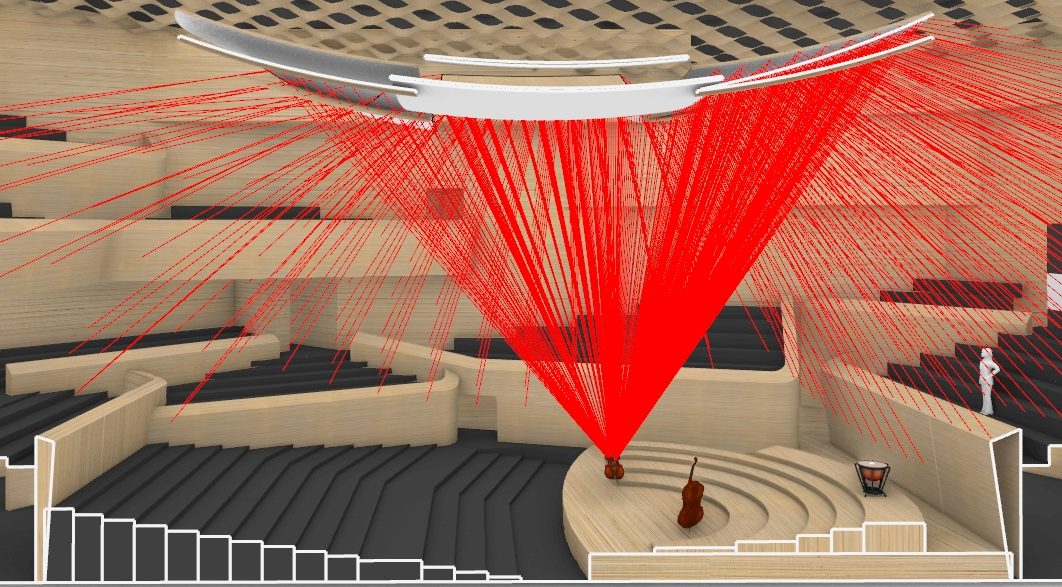
Probably because it is easier. We all wrote a too long report at least once and were all surprised that no one read it. Realizing that, I started in 2008 working directly in the visual environment that architects use. I started doing my ray-tracing in Rhinoceros 3D software where I could modify a 3D geometry, optimize it, check I was actually not going off-track architecturally and send back the modified model to the architect. And guess what, it worked and I was getting far more information across and more efficient collaboration.

15 years down the track, things have evolve and renderers have improved. Acousticians have no more excuses for not making the effort. It is right there at our finger tips:

Visualization of sound reflections from an overhead reflections

More on this can be read here:
https://acousticsrd.com/2022/10/16/new-paper-ica2022-machine-learning-experimentation-for-performing-arts/

Diffusion pattern on ceilings

These types of ceiling are usually hard to design. We need (proper) randomness, we need to control the dimensions of the individual elements, their angles and depths. All this based on the expected reflections path, delays, strength and coverage. Quickly this becomes a multidimensional exercise that is difficult to describe to an architect. So I took a shortcut through parametric.

In the past, many acousticians have resolved to giving their architect a 2D cross section, and a photo, living her to decipher what this means in 3D, at scale for humans. Then comes the wait for a new design, hoping the acoustic requirements were well understood and followed. And it goes back and forth for a while until one says “close enough”.

At least now I can quickly generate an example, send a screenshot, get feedback (and if needed move on to the next idea) promptly. The bonus part is that I have already setup the acoustic requirements, so I know it works.

Here it is in real-time

A beautiful advantage, is that these elements can be catalogued, quantities detailed, possibly costed and optimised, bringing the design closer to a builtable reality.

Acousticians, how do you calculate room volumes?

Acousticians give a lot of meaning to the acoustic volume of a space. Too large and the room can be too reverberant, not loud enough and the early reflections are inaudible. Too small and the room cannot develop enough reverberation and uncomfortably loud.

Get it wrong and the space will have a lifelong handicap. It is not easy to reduce volume, nor is it cheap to increase it later on. So checking the acoustic volume is one of the critical tasks one repeats throughout the design process.

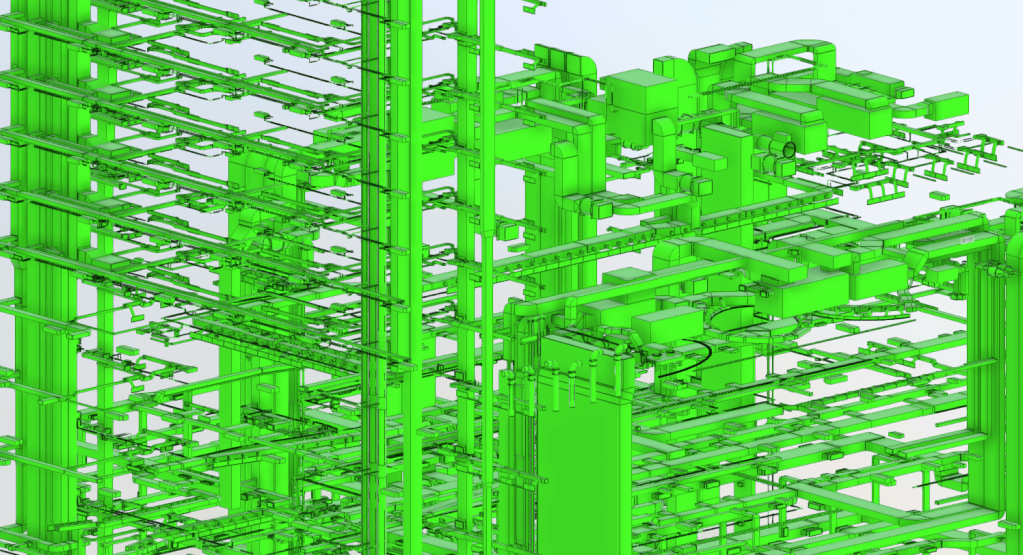
Hand calculations on 2D drawings is the basics. But now days, I receive a 3D model of the hall before I get scaled 2D drawings. Thankfully 3D models have made this easier, but not necessarily faster. Closing a volume air-tight when its complex and inconsistently built is only for the patient amongst us.

So I’ve decided to automate the volume estimation from the 3D model, in Rhino, using some basic Grasshopper tricks. This seems to work fairly well. The accuracy is in par with other approaches and satisfies room acoustics requirements. But the true benefit is that it takes less than a minute and does not require any model manipulation. It can also be made more accurate by drawings sections at 250mm centers for example instead of every meter.

Acousticians, how do you calculate your complex volumes?

And you, how to you calculate your volumes?

World Theatre Day

Since the early 1960s, the World Theatre Day is internationally celebrated on the 27 March. On this occasion, I want to express gratitude to all the crews, staff, production, artists, roadies, cleaner, ushers and anyone involved in making the show go on.

Celebrating small and big stages for the last 20 years, here is a snapshot of my contribution to the performing arts across 4 different consultancy firms and 31 different drama theatres, 8 opera houses and 22 recital and concert halls.

Here looking for another 20 years…

… also wondering when is World Orchestra Day?

Real-time noise prediction for car races in Grasshopper.

I never thought I’d worry myself with traffic noise predictions. Performing arts centers are usually well enough insulated for this to be designed out. We typically focus more on ground vibrations from trams, underground and aircrafts.

But this situation is different. It is not a performing arts center. It is any tower, with an undefined geometry and height, to be built within a race track “loop”.

Traffic noise propagation is a well understood process. But the methods have been developed to protect buildings from the relentless and generally increasing traffic noise from public roads. Not much of the above fits particularly well to a loop with 20-25 high speed performance vehicles.

The basic assumption that a continuous flow of vehicles can be represented by a line source simply cannot be applied to a twisty car race track. Nor can a single number sound power level that ignores spectral character and is derived from vehicle counts (per 18hrs), average speed, proportion of trucks/buses and road surface.

Racing cars typically start together before spreading over the closed loop of the track. They have very distinctive sound spectral signatures (V8, V6, Supercars, motorbikes all sound different). And they travel at much higher speeds on a very special surface.

With these conditions, CoRTN just cannot be applied and one has to look at the PROs and CONs of the European or Nordic methods. These allow at least more detailed descriptions of the cars as noise sources. More precisely, as point sources moving along small segments of a road.

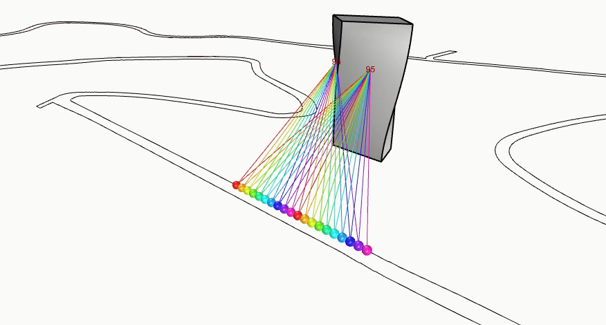
This is precisely what we have implemented in Grasshopper. The definition can take any geometry and location for the tower. The process is:

  • Divide the track into segments travelled for each car, given its own speed, within a 1 second interval
  • Calculate the attenuation of noise through the distance between each car and each facade of the tower.
  • Includes atmospherically conditions (worst case wind)
  • Includes ground attenuation
  • Includes shielding for the facade
  • Includes shielding from noise barriers on the side of the track
  • Does all the above in octave bands
  • Sums up the contribution of all cars for each facade element of the tower, for every 1 second period
  • Stores and trace this incident level as a noise logger would do
  • Extract Lmax, L10/L90 percentiles and Leq for the duration of the race.

The model does not include yet:

  • Road/tire noise component (I am not sure it is relevant for these surfaces and these noisy car/exhausts)
  • Engine breaks and drag noise
  • Speed variations along the track (constant speed regardless of twists and turns)
  • Variable trajectories for each car.

This has been fun! It has allowed us, not only to bet on the cars (randomly assigned speeds) but also to test famous race tracks and see which is the loudest.

Ready, steady, click!

Real-time motor racing noise prediction on a track with Grasshopper

    2022 wrap-up

    2022 was marked by the completion of projects for which I led the acoustic design and the start of several significant commissions for ARD!

    New paper: ICA2022 – Machine Learning experimentation for Performing Arts

    Abstract:

    Designs that do not provide good projection and support for all areas of the stage result in an imbalance of the orchestral sound or noticeable variations depending on where the performer stands. Several years ago, the author et al presented on the importance of whole stage imaging. In this paper, we focus on how a design can be assessed for its capacity to support all sections of the orchestra on stage, from the point of view of the listener. Most simulation packages start with the source definition in a 3-dimensional space. We suggest that the whole stage imaging requires the analysis to be carried out from the listener’s point of view. The paper first explores ways by which the whole-stage imaging can be represented, introducing a new visual tool that carries out the analysis for all possible source positions in real-time at once. We then present a deterministic (but tedious) approach to quantify the results. Finally, the same analysis is carried out using different
    machine-learning processes that attempts at quantifying the whole-stage imaging. It inform,s in a visual way, the imbalance between orchestra sections while facilitating communication with the project architects.

    Keywords: Performing Arts, Ray-Tracing, Whole-Stage, Machine Learning

    New AECOM paper! ANC 2022 – Engineering approach to auralisation in architectural acoustics.

    Abstact:

    Auralisation is to the ears what visualisation is to the eyes. Auralisation is not a new tool. It has long been used for stakeholder engagement and to support design decision. However, it is mostly associated with high-end projects, detailed 3D simulations and even more expensive equipment set precisely in purposely fitted rooms. In this paper, the authors argue that auralisation does not need to be hyper realistic to become an extremely useful tool for stakeholder engagement and design guidance. The authors will present a simplified approach to auralisation, based on standard day-to-day engineering calculations, to cater a wider range of projects and stakeholders. Examples will be given on recent typical acoustic projects including construction noise ingress in a civic building and the building acoustic design of a healthcare facility.

    Keywords: auralisation, convolution, building acoustics, engineering approach