Acoustic design of a theatre โ€“ Day 2

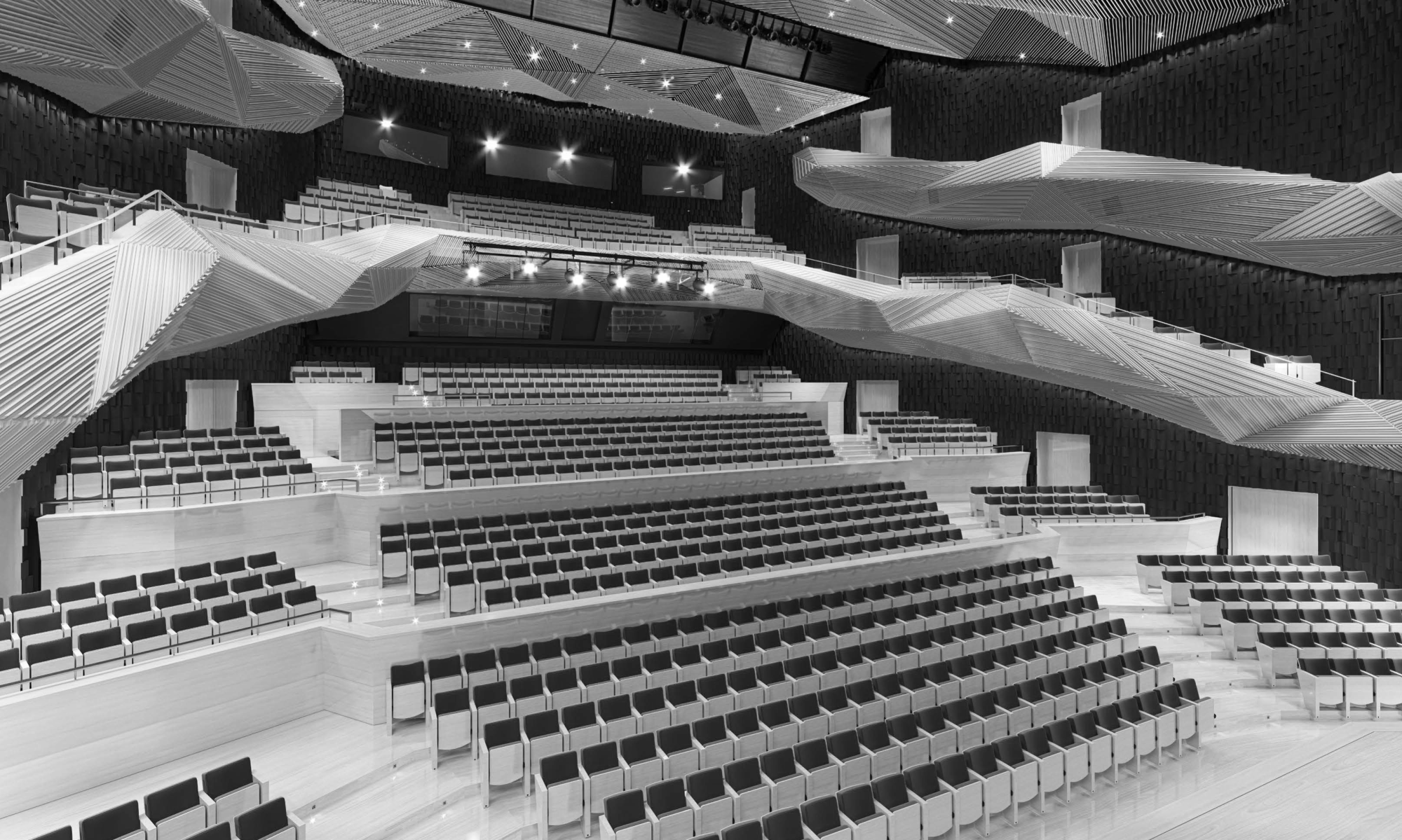
Today we are finally reviewing the interior design for a 1200-seat grand theatre. We always start with a review of the current geometry performance. Understanding how the room works and the potential for each surface and architectural element is critical to us.

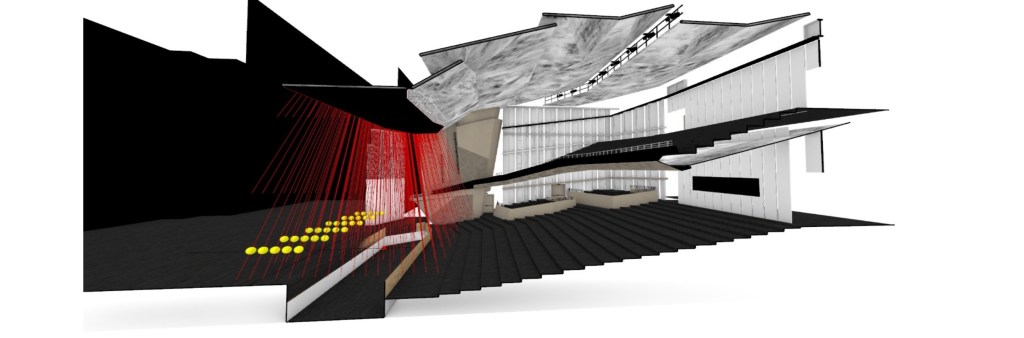
We always start with one of the most critical zone, close to the sources. In todayโ€™s case, the sources are on stage and in the orchestra pit.

We make sure that the surfaces promote good communication between pit and stage. This is not only relevant for western opera. In XIQU performances, the lead musician in the pit and performers on stage are in constant visual and aural communication, giving each other cues for rhythms and phrases.

Source in pit, reflection path to the stage

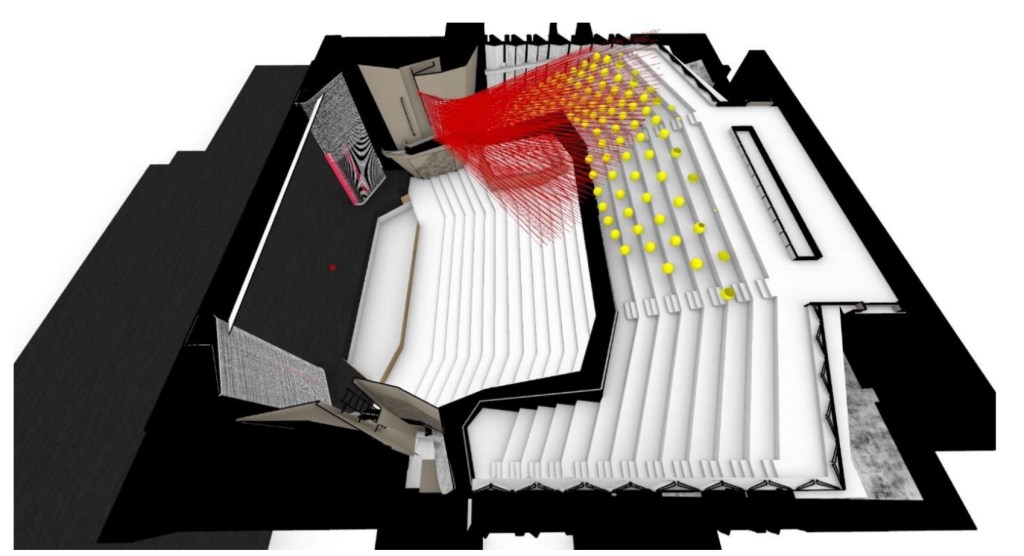
These surfaces are not necessarily dedicated to this reflection path, they also are designed to project overhead reflections for the audience in the stalls. Although such reflections do not assist with envelopment, they boost clarity, speech intelligibility and early loudness. They promote the โ€œPresenceโ€ of the performer, highlight the precision of the work and the attack.

Overhead reflections from stage to audience

1200-seat theatre naturally ventilated

The design and construction of the 1200-seat multipurpose Grand Theatre in Hanzhong is going at full speed!

We are proud of being part of the team, responsible for the room acoustic design. But maybe what makes this project unique is that the main auditorium will be naturally ventilated.

That is right! Four large shafts will link directly the grand theatre to the outside. The average temperature and humidity in the city was found ideal for such development.

A unique feature that will actually meet the needs for energy saving, sustainability objectives as well as COVID-19 most stringent recommendation: 100% fresh air 100% of the time!

We are proud of be part of this!

Do you know Orchestra shorthand for instrumentation?

Did you know that orchestras have a nomenclature to precisely define the size of each section of the orchestra?

Here is an example:

3222.4231.T.1P.Str 12,10,8,7,5

In layman terms, the first 4 digits tell us that there are 3 flutes, 2 oboes, 2 clarinets and 2 bassoons.

The second 4 digits translate into 4 horns, 2 trumpets, 3 trombones and 1 tuba.

Then you have 1 timpani and 1 percussionist.

Finally, the string instruments with 12 first violins, 10 second violins, 8 violas, 7 cellos and 5 basses.

And here what it looks like:

Acoustic design of a theatre – Day 1

It is good to be back into the thick of it: performing arts design. Today, it is a 1200 seat theatre. And there is a lot of work to be done.

First, this will be analysed in Rhino and Grasshopper for acoustic volume estimation, sightlines, ray-tracing and estimations of source strength (G), sound clarity (C80, C50) and the general early efficiency of the room.

Then, the model will be optimised to achieve the most even coverage of early lateral reflections and finally, we will run simulations to quantify the changes.

The 1200 seats will enjoy excellent acoustic conditions. Let’s get to work on that.

We will post updates as things progress. The ray-tracing has seriously evolved since our last publication on it. Stay tuned!

ODEON ready!

The ODEON license is here! We are now ready to help with simulations! Call if you need support with your project.


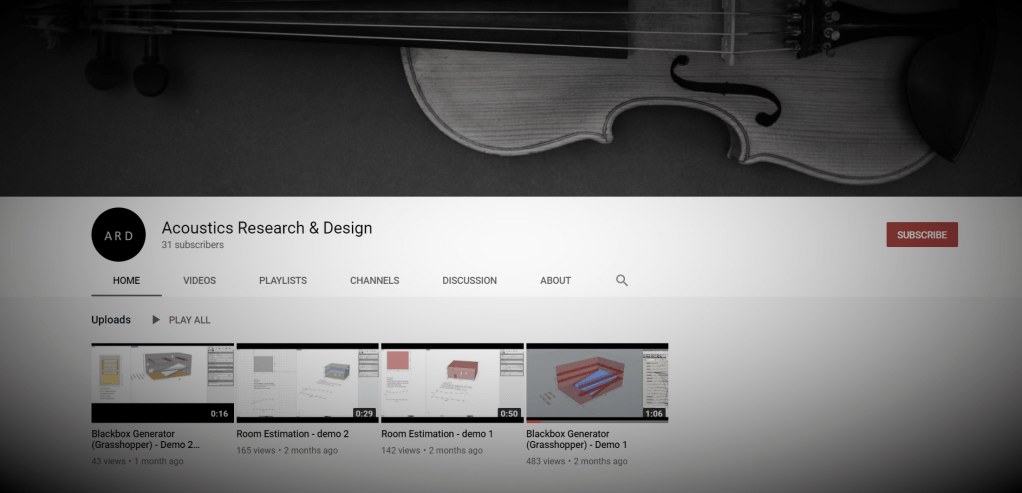
Follow us on YouTube

We will post videos to update on our tool developments for architectural acoustic design.

Subscribe to our channel and participate to the discussion or suggest a research topic:

Link to our YouTube channel
(Click on the image to visit our channel and subscribe!)

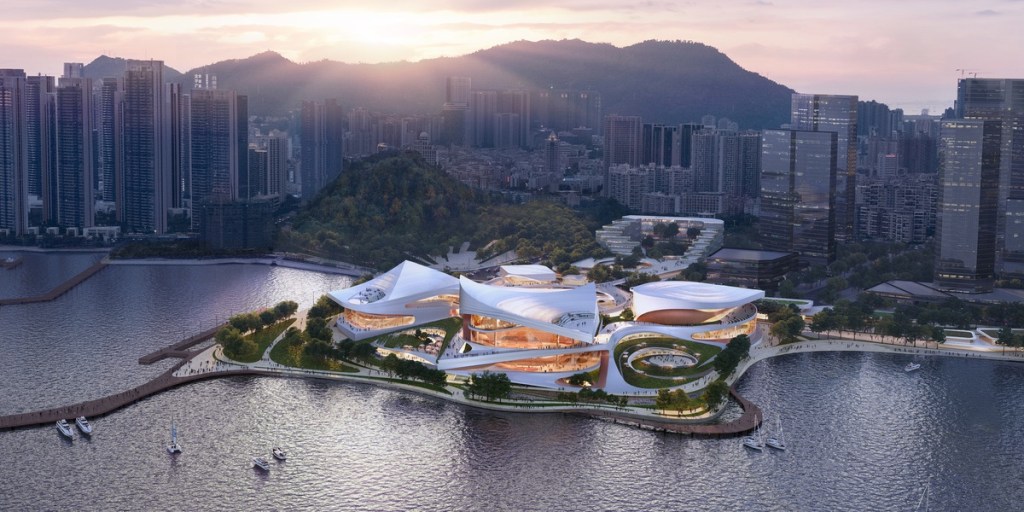
Shenzhen Opera House

Although it didnโ€™t win this time, UNStudio has revealed the design proposal for the Shenzhen Opera House. The team at UNStudio Shanghai and I worked several months on this and the result would have been a great development for Shenzhen.

(c) UNStudio

(Click on the image to visit their detailed page)

Website launch!

Today, we pushed โ€œlaunchโ€ and it felt great!

Tomorrow, we will continue to populate the site, make it clearer, more useable.

We also plan to have a Download section for all these generative design tools we do on the side. So please get in touch if you want us to look at something in particular!

Quick Reverberation Estimation, in 3D

When you have 200 rooms to scale for a project and very little time, you need a visual tool that can help you resolve bills of quantities, acoustics and proportions of the space. We are working of a Quick RT calculator directly in Grasshopper. It feeds the basics room list from an Excel spreadsheet and based on simple criteria, can assist you with getting all your volumes and quantities of acoustic finishes into the spreadsheet. By the way, it also creates 3D models for export or reuse in the model.

Demo 2 (Getting there, slowly)
Demo 1 (Original idea)

Automated Blackbox Theatre Generator

Can we assist architects during the intense period of a design competition with a volume holder for a Blackbox theatre? Giving volumes are great, but what if it was a little bit more advanced? What if it could be rendered as well and include useful information about foyer levels and access routes?
Or simply a tool to assist a client with visualizing what a 400m2 footprint can get them?

Demo 2 (Work in Progress)
Demo 1 (Getting exciting)