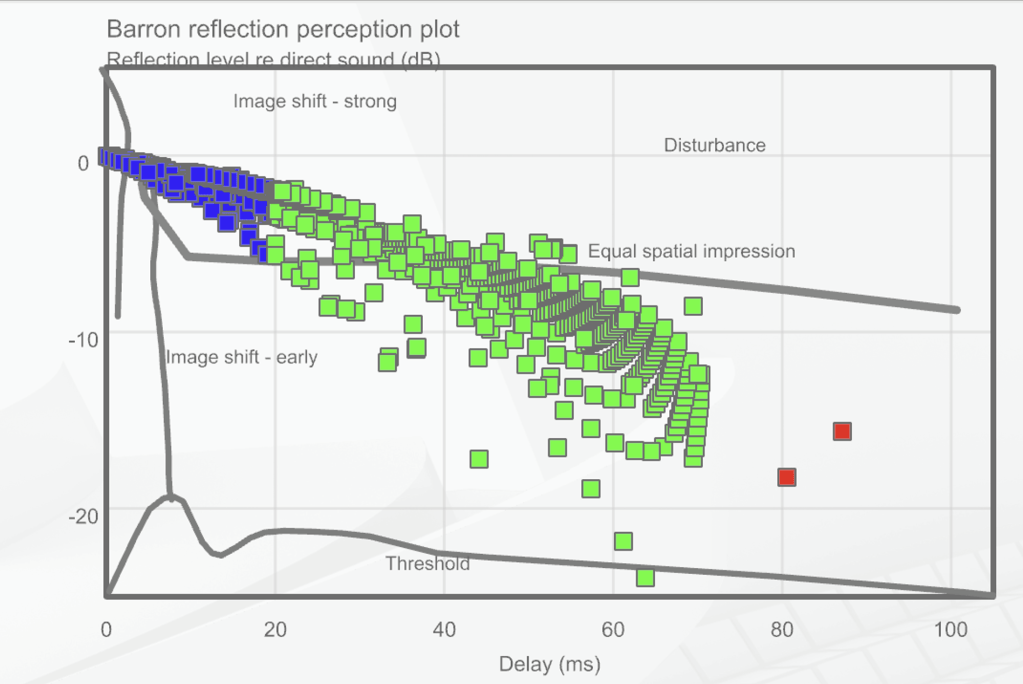
In his book Auditorium Acoustics and Architectural Design (one of the most helpful ones), Mike Barron includes Figure 3.2, based on the subjective effect of a single side reflection, with the reflected sound at about 40-degree azimuth, relative to the direct sound. The figure shows that the perceptual effect depends on both the delay and level of the reflection relative to the direct sound. Barron then moves from this single-reflection picture to the broader concept of early lateral energy as the practical descriptor of source broadening and spatial impression.
Barron’s plot (as I have called it since the 2010 edition) has long been part of my toolkit. It tells us whether a reflection created by a given surface contributes to the spatial impression of the hall, produces an undesirable image shift or disturbance, or just is too weak to contribute meaningfully. I like to see how far a reflection sits relative to the curve of equal spatial impression at 250Hz and 1 or 2kHz.
But a reflector is not designed for one seat. It is intended to serve a section of the audience. So when assessing the reflector itself, the Barron Plot really needs to be considered across the entire audience area covered by it.
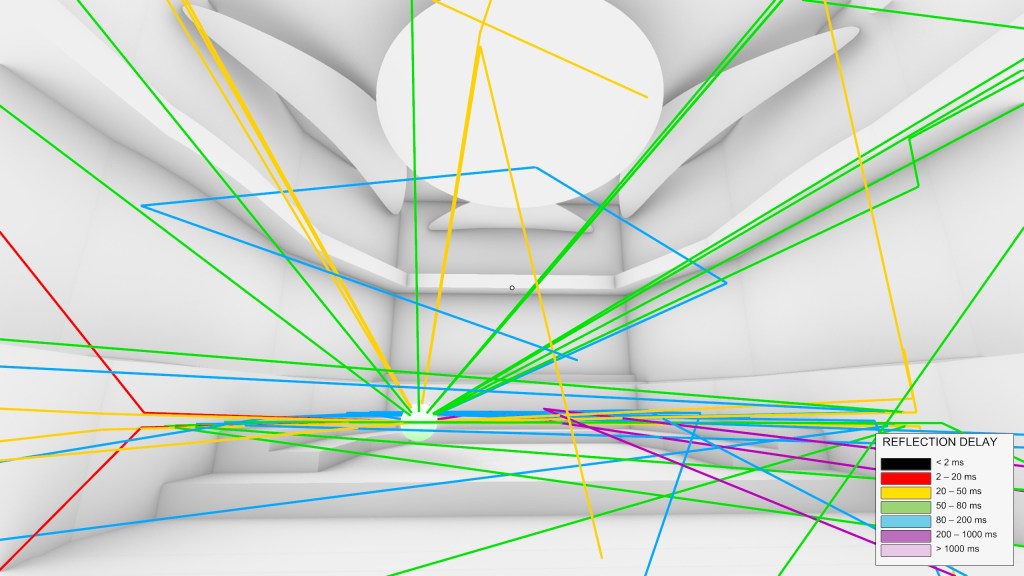
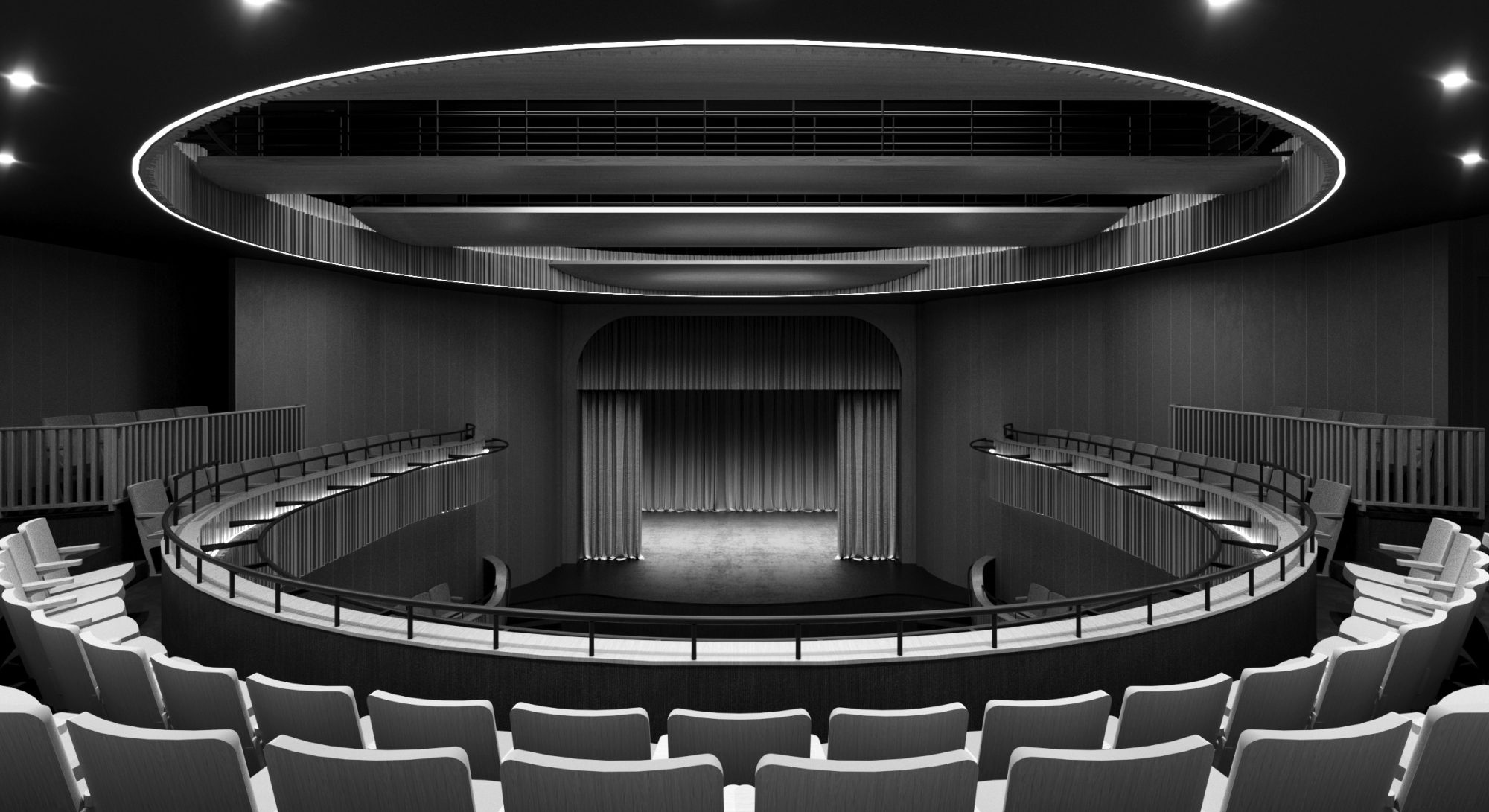
A couple of weeks ago, I got seriously distracted during the concept design of a 1,800-seat concert hall and implemented this into my usual Rhino-native ray tracing. First, the original published graph had to be turned from a page scan into numerical functions. Then those functions had to be reproduced in the modelling viewport. Finally, I fed them the delays and energy levels relative to the direct sound for all the calculated reflections at once.
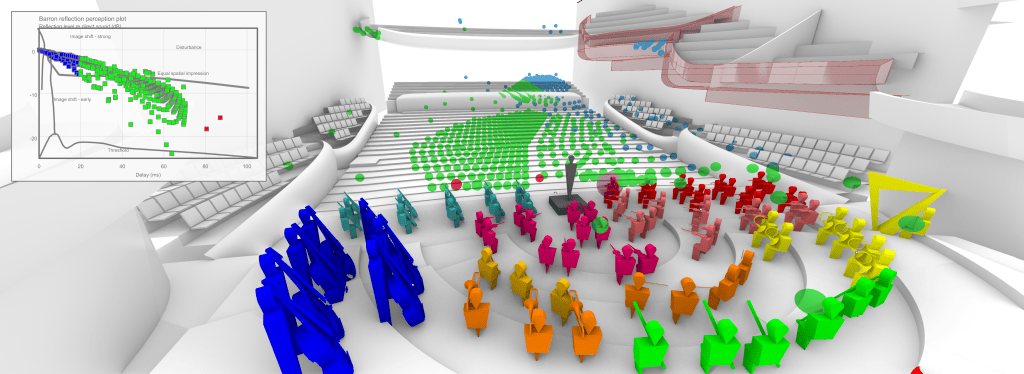
What I found is that this gives an almost instantaneous assessment of where each part of a reflector sits on the spectrum between image shift, useful spatial impression, and disturbance. So perhaps not quite a distraction after all.
Next step:
We also know that one reflection is unlikely to tilt the balance on its own. It takes a sequence of reflections to shape the spatial impression of a space. The Barron Plot should also be considered for the entire reflection sequence at a given receiver position.
I suspect that looking at that sequence and particularly at how the reflections in the sequence distribute near (or far from) the equal-spatial-impression curve could tell us something about the spatial dynamics of the room (early part) and perhaps how the room presence starts emerging earlier than we may think. And the work I presented at Internoise2026 seems like a good starting point for exploring that.
Stay tuned.